What divers should know about Lionfish
Lionfish (aka Zebrafish) is a common name for a genus of venomous fish commonly found in tropical reefs. Native to the Indo-Pacific, Lionfish have become an invasive species in the western Atlantic and can be found as far north as Rhode Island.
While not a threat to divers, the invasion of this greedy predator in exotic ecosystems has the potential to destroy juvenile species. In an attempt to control the spread of lionfish populations, recreational divers in the Americas have started aggressive campaigns to hunt them; in the process, many divers are stung with their sharp spines, which cause very painful and sometimes complicated wounds.
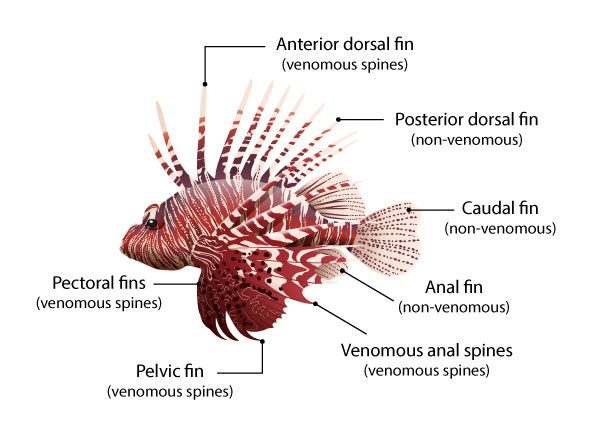
Lionfish Are Venomous
- 18 venomous spines that should be avoided as they can cause painful injuries.
- 13 long venomous spines are located along the front of the dorsal fin which is located on the top of the fish.
- 2 short venomous spines are located on each side of the pelvic fins, which are located on the bottom of the fish closest to the head.
- 3 additional venomous spines can be found along the front edge of the anal fin which is located on the bottom near the tail.
- The large and featherlike pectoral fins and the tail fin do not contain venomous spines.
First Aid Guidelines
- Rinse wound with clean water.
- Remove any obvious foreign material.
- Control bleeding if needed.
- Soak wound in hot water for 30 minutes. Repeat if necessary.
- First test the hottest water you can tolerate on yourself in the same area.
- Monitor vital signs while en route to professional medical evaluation.
- Life-threatening complications are rare but may occur.
DAN Customer Service
Mon–Fri, 8:30 a.m. – 5 p.m. ET
+1 (919) 684-2948
+1 (800) 446-2671
Fax: +1 (919) 490-6630
24/7 Emergency Hotline
In event of a dive accident or injury, call local EMS first, then call DAN.
24/7 Emergency Hotline:
+1 (919) 684-9111
(Collect calls accepted)
DAN must arrange transportation for covered emergency medical evacuation fees to be paid.
Medical Information Line
Get answers to your nonemergency health and diving questions.
Mon–Fri, 8:30 a.m. – 5 p.m. ET
+1 (919) 684-2948, Option 4
Online: Ask A Medic
(Allow 24-48 hours for a response.)